

5 Most Rewatchable Episodes Of Stargate SG-1
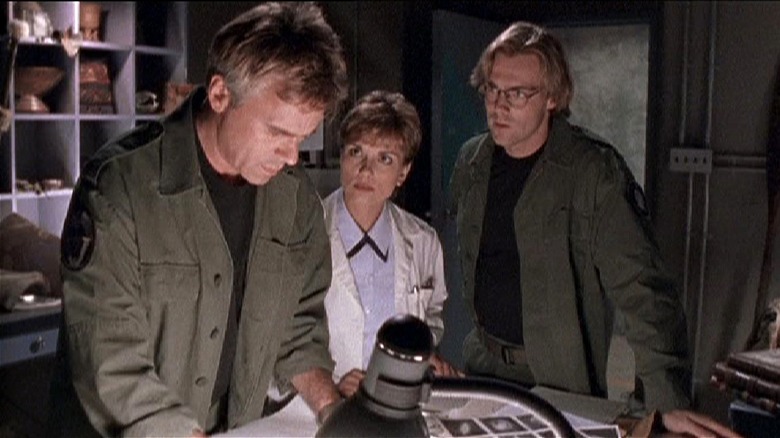
In 1994, Kurt Russell starred in a science fiction military movie called "Stargate," launching a franchise that would continue on the small screen only three years later. "Stargate SG-1" aired on Showtime, taking the movie's premise and expanding on it significantly, creating an entire universe's worth of lore to propel its narrative. "Stargate SG-1" focuses on the titular team, which initially consisted of Col. Jack O'Neill (Richard Dean Anderson), Dr. Daniel Jackson (Michael Shanks), Capt. Samantha Carter (Amanda Tapping), and Teal'c (Christopher Judge), a Jaffa warrior who joins the others to fight the Goa'uld.
"Stargate SG-1" ran from 1997 until 2007, releasing a total of 214 episodes and two direct-to-DVD movies. The show has more episodes than any individual "Star Trek" series — and more than most sci-fi shows — made before or since. Throughout its run, "Stargate SG-1" features numerous overarching storylines, multiple cosmic threats, plenty of humor, and a lot of drama, making for some of the most satisfying sci-fi in TV history. It spawned several spinoffs, and many of the series' episodes are highly rewatchable.
There are tons of episodes that are fantastic, but they aren't necessarily those you'd want to watch on repeat. While the rewatchability of a series' best episodes is certainly subjective, some are exceptionally suited for multiple viewings. This is often due to their contributions to the franchise, their humor, action, overall popularity, and, of course, the incredible writing and acting on display. Each of these five episodes of "Stargate SG-1" is forever worth the revisit, and they're arranged in no particular order.
The Torment of Tantalus (Season 1, Episode 10)
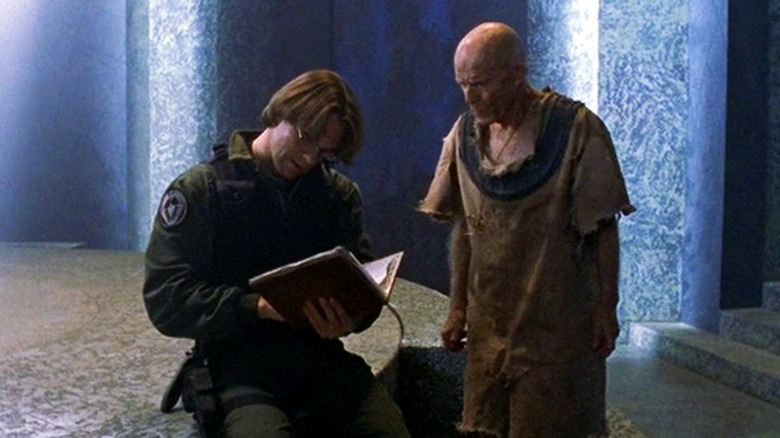
In "The Torment of Tantalus," SG-1 manages to track down Catherine Langford's (Elizabeth Hoffman) long-lost fiancé, whom Daniel learns was the first person to step through the Stargate. He did so in 1945 and never returned. After he's located, living alone with barely a scrap of clothing, Dr. Littlefield (Keene Curtis) shows the team the ruins where he's lived for more than 50 years, and it's in danger of falling into the sea. The Dial Home Device is also destroyed, creating new problems in getting home.
While that's happening, Dr. Littlefield reveals to Daniel what he's learned, showing off a holographic computer system detailing many of the galaxy's secrets, including its four dominant races. Daniel is struck by the sheer volume of information and becomes obsessed with acquiring it. Unfortunately, a coming storm and the danger to the structure make time an issue. Daniel nearly succumbs to his bookish desires, and is forced to abandon the place so he and the rest of the team can return home.
Daniel has always been a data-driven historian, and the trove of information at his fingertips is definitely tantalizing, which loops the episode's title into a string of wordplay that correctly describes Daniel's emotional plight. When it's clear that the gate's address no longer works, Daniel takes solace in understanding that he might one day meet the people who created it, but he's still left despondent at the loss. It's a fascinating episode that hints at the series' wider lore early in its run, helping to make it a fan-favorite.
Within the Serpent's Grasp & The Serpent's Lair (Season 1, Episode 21 & Season 2, Episode 1)
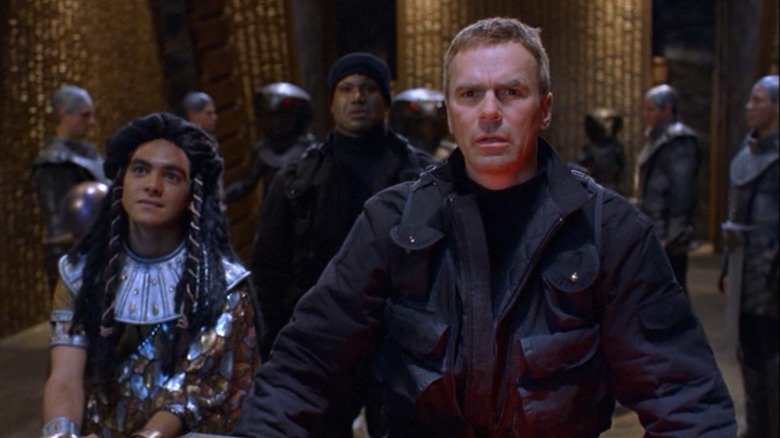
The first season of "Stargate SG-1" emphasizes the dangers posed by the Goa'uld, especially Apophis (Peter Williams). In the Season 1 finale and Season 2 opener, "Within the Serpent's Grasp" and "The Serpent's Lair," SG-1 violates orders and uses the Stargate in an effort to thwart Apophis' planned invasion of Earth after the Stargate program is shut down by Senator Robert Kinsey (Ronny Cox).
They walk through the Stargate, but instead of arriving on a planet, they step onto a massive battleship. The team plants C4 explosives throughout the vessel to take it out, but another starship is revealed to be part of the invasion force, altering their plans. They meet and receive help from Bra'tac of Chulak, the former First Prime of Apophis and Teal'c's mentor, played by Tony Amendola, who has appeared in multiple sci-fi franchises.
The presence of Klorel (Alexis Cruz, who played Skaara, this being's human host in the original film) presents a problem, but with some effort, the team not only manages to thwart the invasion but also proves to the Goa'uld that humanity is now a force to be reckoned with. This two-part story is one of many mini-events throughout the series, but it's the first that has such an impact on the wider lore. It's packed with desperate action to stop an invasion against terrible odds, making these two episodes some of the best and most rewatchable in the entire franchise.
Nemesis (Season 3, Episode 22)
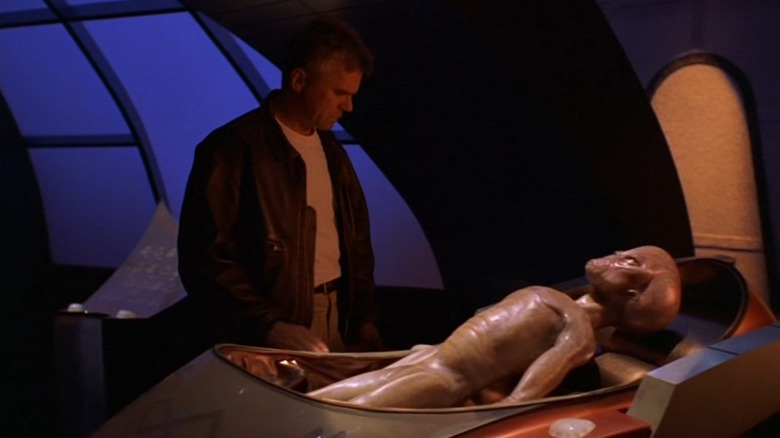
As the "Stargate" timeline moved on from just the one major threat of the Goa'uld, it introduced another that is far more insidious: the Replicators. The first time these artificial beings are seen on screen is in "Nemesis," where Jack is suddenly transported to Thor's ship, discovering that their alien ally is incapacitated and needs help — the Replicators have taken over his vessel. This happens within Earth's orbit, as the Replicators have plans to utilize our entire world for their needs, effectively destroying it in the process.
Eventually, the team pops up to assist, and they quickly learn that good, old-fashioned shotgun blasts can disrupt the Replicators. Unfortunately, there are so many new baddies that stopping them all becomes impossible. They set off a plan to destroy the ship and beam up Stargate Command's main Stargate so they can escape with Thor. They pull it off, gating to P3X-234, and then returning through the Beta Gate, which was previously discovered buried in Antarctica.
Unfortunately, one Replicator survives and is seen crawling on some debris, floating on the ocean. The episode's introduction of the Replicators makes it one of the series' best, and Jack's characteristic nonchalance over the whole affair makes it funny when everything that happens on board Thor's ship is so dire. Not long after the episode, the Replicator threat grows. Eventually, it destroys the Asgard civilization, but before that can happen, the team must contend with the Replicators still on Earth.
The Fifth Race (Season 2, Episode 15)
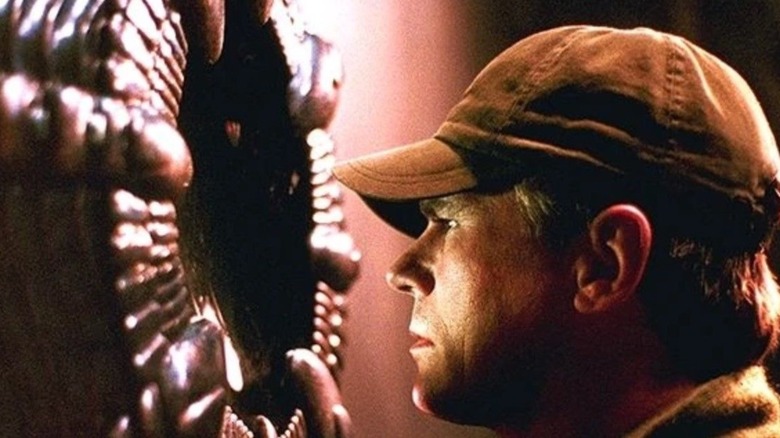
Jack is often depicted as less intelligent than he is throughout the series, but he's a highly capable military officer. Daniel and Carter are better educated, but in "The Fifth Race," the dynamic flips in Jack's favor, and not in a good way. After peering into an alien artifact, Jack has a near-infinite amount of knowledge crammed into his cranium. He begins speaking Ancient, and later loses the ability to communicate at all. He then constructs a device that supercharges the Stargate.
The team is helpless to stop him or even render aid, as the information in Jack's head begins to completely take over his body's ability to function. Once his device is in place, he powers it up. It automatically dials the gate, but instead of using seven chevrons like usual, it dials eight. This allows for a connection between this gate and a new one that sits outside of the Milky Way galaxy. With the added power his machine provides, Jack steps through, making contact with the Asgard race.
They explain that there was once an ancient Alliance of Four Great Races. With humanity's newest efforts, they tell Jack that humans have taken the first step in becoming the Fifth Great Race. The episode is one of Jack's best, and while Anderson would eventually leave "Stargate SG-1," "The Fifth Race" stands as one of his best early episodes, proving his character's importance throughout not one, but at least two galaxies.
Window of Opportunity (Season 4, Episode 6)

Of all "Stargate SG-1's" episodes, the one that is arguably the funniest is "Window of Opportunity." It's a time loop episode: Teal'c and Jack are the only ones stuck on repeat after a scientist incorrectly manipulates an Ancient device in an effort to restore his lost family. Eventually, the team understands the problem and stops the glitch, but that's not why the episode is one of the show's most rewatchable — it's the hilarious loops the two team members are stuck in.
Jack repeatedly resets to a point at breakfast when Daniel asks him what he thinks about something he's been talking about. Of course, Jack doesn't have a clue, but for Teal'c, it's more frustrating. His loop resets the moment before an airman opens a door into his face. This reasonably gets on his nerves, though he's gamely polite about it. As the loop progresses, they play golf with the longest-recorded drive in the history of the game, and in one, Jack resigns so he can make out with Carter right in front of Gen. Hammond (Don S. Davis).
It's a fun exploration of the possibilities open to the two characters, much like Bill Murray's experiences in "Groundhog Day." While there are plenty of dumb things we ignore in "Stargate," like Zats, there's no denying that "Window of Opportunity" pokes as much fun at the series as possible. That makes it easily one of the best, most rewatchable episodes in the entire franchise.